
Synagogue
Historical background
One of the most important historical and cultural phenomena of Wrocław is its multiculturalism. Remaining within changing state formations, located on trade routes and migration paths, it became a home and a small homeland to many nations and faiths for long periods. Jews became one of the important factors shaping the image and genius loci of the city on the Odra River almost from the beginning of its history. The documented history of their presence in Wrocław dates back 800 years, but it is undoubtedly even older. This presence, although interrupted by persecutions and expulsions, was significant for the city and initially also for its economic development. However, discrimination and isolation did not favor a broader inclusion of Jews in political and cultural life over the years. The situation changed with the incorporation of Wrocław into dynamic and modern Prussia. The golden age of German Jews began.
First plans
The end of the 18th century, associated by Poles with tragic partitions, was the period of the Enlightenment in Prussia. At that time, the Jewish community was gradually granted civil rights, which helped it flourish. In 1790, for example, the Minister of Silesia, Count Karl Georg Heinrich von Hoym, proposed building a public synagogue that would serve the entire Jewish community and simultaneously allow the authorities full control over the community. This single synagogue was to replace all prayer houses scattered around the city. However, this plan was blocked by orthodox Jews who perceived emancipation as a threat to their religious identity.
Despite Jewish resistance, the pressure from the authorities in Berlin on the Jewish community intensified. This resistance, going beyond conservative Jewish circles, resulted from a lack of funds and the still unregulated status of Judaism in the Prussian constitution. In 1820, the authorities finally forced the decision to build a synagogue. In 1819–1820, significant funds were raised for the project and a location was secured for the temple on a plot at 35 św. Antoniego Street, where the White Stork Inn previously stood, from which the synagogue 'inherited' its future name. According to some sources, the name of the synagogue came from a tannery belonging to the Stork family. An architectural plan was also ready. This time, religious disputes in the highly divided Jewish community led to the suspension of construction.
Construction of the synagogue
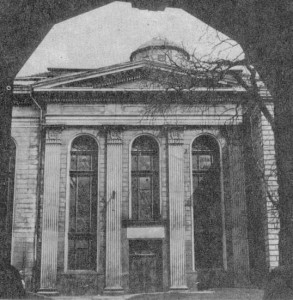
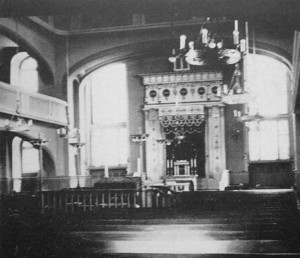
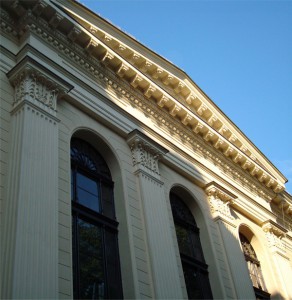
The project to build a representative synagogue was revived in 1826 on the initiative of liberal Jews gathered in the First Society of Brothers. Construction work began a year later. The most prominent figures associated with this undertaking were the investor Jakob Philip Silberstein, master masons Schindler and Tschoke, and construction supervisor Thiele. The prominent German architect Carl Ferdinand Langhans designed a neoclassical temple, the interior of which was decorated by Jewish painter Raphael Biow. The first service was held on April 10, 1829, 13 days before the official opening ceremony of the synagogue.
For the next 18 years, it functioned as a private temple of the Society, only to become the main and public synagogue of the growing and increasingly important liberal faction of the Wrocław Jewish community in 1847.
From liberal to orthodox
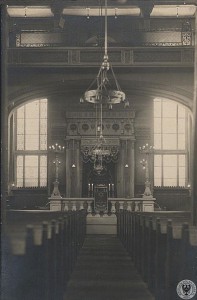
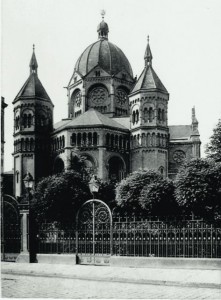
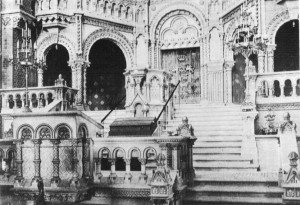
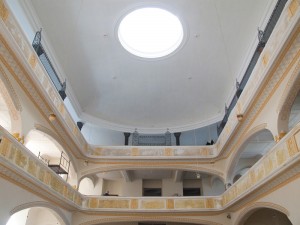
In 1872, the majestic New Synagogue on Podwale Street was established, to which liberal Jews moved, while conservative Jews took over the White Stork Synagogue. The religious requirements of gender separation during services disrupted the harmonious composition of the building by adding three external staircases leading to the women's galleries. The reconstruction carried out by Paul and Richard Ehrlich in 1905 left behind reinforced concrete, neo-Romanesque women's galleries. A significant and radical modernization of the synagogue took place on the centenary of its existence. In 1929, the facades and interior were renovated, central heating and electric lighting were installed, and a bimah was built in the middle of the synagogue.
Surviving Nazism
During "Kristallnacht" on November 9-10, 1938, Nazi militias devastated the interior of the synagogue. However, due to the close proximity of other buildings, it escaped the fate of the New Synagogue, which was burned to the ground. The temple served as a place of prayer for conservative and liberal Jews until their arrest. In 1943, the Nazis converted the interior of the synagogue into a car workshop and warehouses for looted Jewish property.
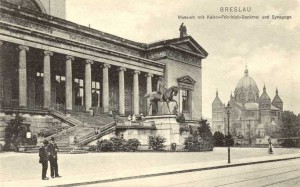
Some of the original furnishings of the temple were destroyed at that time. The synagogue's courtyard became an Umschlagplatz, an assembly point for Jews deported to extermination camps. Wrocław's German Jews disappeared from the city. About half of them managed to escape arrest, while the rest were murdered in concentration camps.
Part of Poland
As early as August 13, 1945, the Jewish Committee in Wrocław, representing the surviving Polish Jews who settled here after the war, asked the mayor of the city, Aleksander Wachniewski, for the return of the synagogue, then occupied by the industrial militia. The Committee renovated the recovered synagogue and adapted it back to the needs of religious worship.
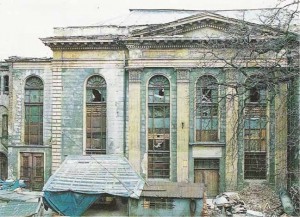
Subsequent waves of Jewish emigration from Poland, the discriminatory policy of the authorities, and acts of vandalism by "unknown perpetrators" contributed to the gradual degradation of the building. In the 1960s, the White Stork Synagogue served as a center of worship and a meeting place for several thousand Wrocław Jews. In 1966, the communist authorities closed the synagogue, pointing to the deplorable state of the facility.
A year later, following the intervention of the Israelite Congregation, permission was obtained to use the lower part of the synagogue, and only during specific holidays. Following the demolition of surrounding houses, the temple lost its natural protection and became an even easier target for vandals who broke all the windows, thus accelerating the process of further devastation.
The anti-Semitic campaign in 1968
The year 1968 was another dark year in the history of the Jewish community of Wrocław and its synagogue. The last wave of Jewish emigration, largely forced by the anti-Semitic campaign, led to the suspension of services in the synagogue.
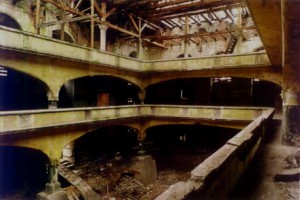
In 1974, the synagogue was taken over by the State Treasury and handed over to the University of Wrocław. A library and reading rooms were to be created in its interior.
Adaptation works, begun in 1976 and soon abandoned, only led to even greater devastation of the building. Purchased in 1984 by the Center of Culture and Art, it became a venue for artistic performances for a few years. Further destruction – mainly as a result of two fires – led to another change of owner. In 1989, it became the Academy of Music in Wrocław, planning to build a concert hall. However, after the roof was removed, all work ceased, and the temple, left to its fate, fell into total ruin. Another private owner from 1992 contributed even more to the deterioration of the building's condition.
Democracy
Despite political changes in 1989 and the goodwill of the new, democratic local and national authorities, several more years passed before the White Stork Synagogue returned to its rightful owner — the Jewish community of Wrocław. Henryk Cardinal Gulbinowicz, Archbishop Senior of Wrocław, persuaded the Ministry of Culture and National Heritage to buy the synagogue, which on April 10, 1996, was handed over to the reborn Jewish Religious Community in Wrocław.
One cannot also forget Eric F. Bowes, an American Jewish activist born in Breslau, who was one of the first initiators of the reconstruction of the White Stork Synagogue. Unfortunately, he died in 2007, not living to see the opening of the synagogue. In September 1995, the first service for the holiday of Rosh Hashanah was held in the ruined synagogue, attended by about 400 people. At that time, the Choir of the White Stork Synagogue, directed by Stanisław Rybarczyk, performed for the first time.
The beginning of the renovation
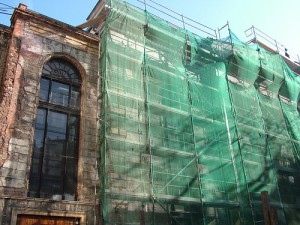
In May 1996, the Jewish Community in Wrocław began the process of renovating the synagogue building, supervised by Anna Kościuk, the architect of the entire synagogue restoration process. Renovation works, financed by the Foundation for Polish-German Cooperation, focused on rebuilding the synagogue's roof. Plans for further renovation were based on existing archival photographs. In 1998, thanks to a grant from KGHM Polska Miedź S.A., the third stage of renovation was completed.
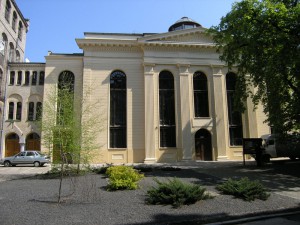
In November 1998 – 60 years after the events of Kristallnacht – a special service took place in the synagogue. Present were Jerzy Buzek, then Prime Minister of the Polish government and currently President of the European Parliament, and Bogdan Zdrojewski, then Mayor of Wrocław and current Minister of Culture and National Heritage. This was the culmination of efforts to recover and save the synagogue led by Michael Schudrich, the current Chief Rabbi of Poland, and Jerzy Kichler, then chairman of the Union of Jewish Religious Communities in Poland and the Jewish Religious Community in Wrocław. Jerzy Kichler's actions were continued by subsequent leaders of the Jewish community – Ignacy Einhorn and Klara Kołodziejska, Karol Lewkowicz and Józef Kożuch.
Bente Kahan Foundation
On May 7, 2005, the Center for Jewish Culture and Education was established at the Wrocław branch of the Union of Jewish Religious Communities in Poland, administered by the Bente Kahan Foundation. Bente Kahan, a prominent Norwegian and Jewish artist who settled in Wrocław in 2001, is the director of the Center and the artistic director of the Synagogue. The Bente Kahan Foundation, together with the Wrocław branch of the Union of Jewish Religious Communities in Poland, joined efforts aiming at the further renovation of the White Stork Synagogue. In 2006–2008, using municipal funds, the southern facade of the synagogue was renovated, and the Aron Kodesh was restored. The basements were also drained, and works protecting the building from moisture were carried out.
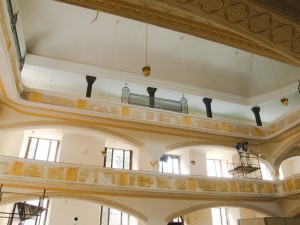
A consortium established in 2006 by these institutions – together with the City of Wrocław – and managed by the Bente Kahan Foundation successfully strives to obtain significant financial resources for the full restoration and renovation of the White Stork Synagogue and the courtyard in front of it. The works, which began in the fall of 2008 and ended by the spring of 2010 at the latest, worth approximately PLN 10 million, will be financed by EEA Grants (funds from non-EU countries of the European Economic Area, won by the consortium in a competition for restoration projects of historic buildings announced by the administrator of the Polish part of the grant – the Ministry of Culture and National Heritage), the Municipality of Wrocław, and the owner – the Union of Jewish Religious Communities in Poland.
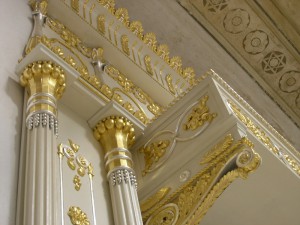
The synagogue will continue to perform cult functions, and will also strengthen its role as a modern center of culture and education with an international dimension, including the creation of the Jewish Museum in Wrocław in its basements and on its balconies. The city will fully regain the Jewish part of its soul!
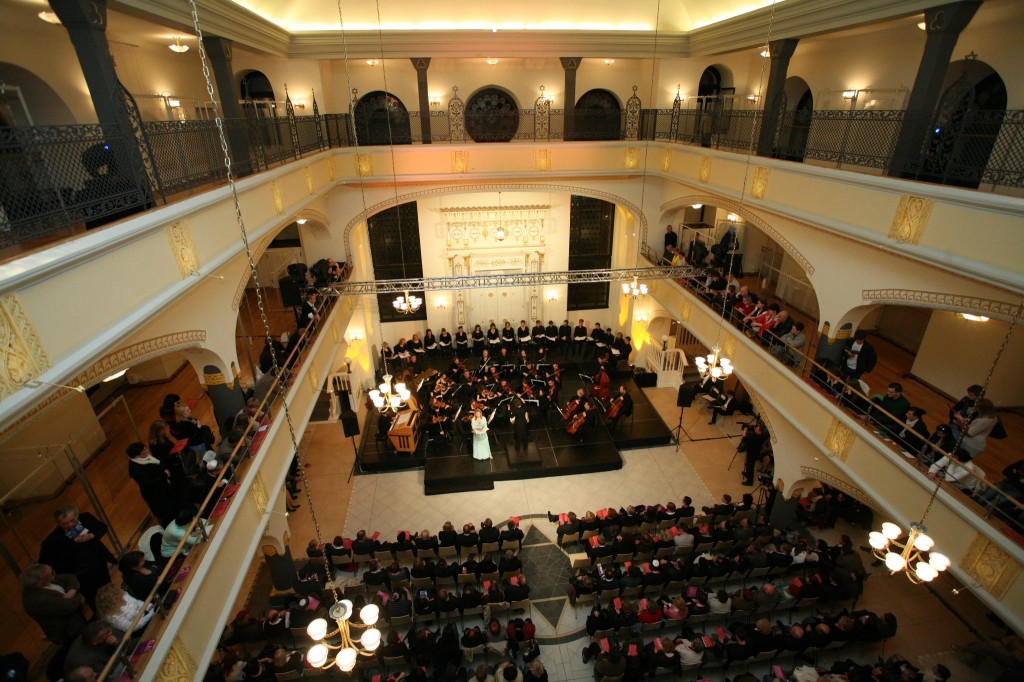
For a dozen or so years now, the White Stork Synagogue has been not only a place of religious practice but also a dynamically developing center of Jewish culture, hosting numerous exhibitions, concerts, vernissages, theatrical performances, workshops, and meetings. This is due to the excellent acoustics of the facility, as well as its size (it can accommodate several hundred people). Since 1999, monthly Havdalah concerts have been held here – presenting klezmer, synagogal, Jewish classical music, and cantorial songs. Traditionally, the annual Simcha Jewish Culture Festival attracts a large audience. Both events are organized by Stanisław Rybarczyk and Karolina Szykier – from the Pro Arte Foundation.
The opening of the Center for Jewish Education and Culture in 2005 brought a significant revival of the synagogue. Suffice it to mention some of them, largely organized by the Bente Kahan Foundation:
The annual Summer with Music Under the White Stork, a series of summer Sunday concerts of music by Jewish composers and those of Jewish descent, from jazz to opera. The concerts are accompanied by Israeli dance workshops conducted by Małgorzata Rzempołuch.
The annual Israel Day, bringing the present day of this country closer to the inhabitants of Wrocław. The day is always filled with theater, film, music, workshops, exhibitions, fairs, and lectures.
Theatrical performances – both open and for schools. Bente Kahan's musically rich plays "Voices from Theresienstadt", "Wallstrasse 13", and "Home", depicting the dramatic and complicated fates of Jews against the background of the history of Europe and Wrocław, have permanently entered the repertoire.
Exhibitions, workshops
Anniversary celebrations, especially the artistically rich commemorations of the anniversaries of Kristallnacht, ending with a March of Remembrance to the place where the New Synagogue, burned in 1938, stood.
Occasional ceremonies and concerts, suffice it to mention the ceremony of awarding the "Righteous Among the Nations" medals and the commemoration of the anniversary of the martyrdom of the "volunteer to Auschwitz", Cavalry Captain Witold Pilecki.
The synagogue belongs to the so-called District of Four Temples (often also called the District of Mutual Respect), which also includes the Orthodox Cathedral of the Nativity of the Most Holy Mother of God, the Roman Catholic Church of St. Anthony of Padua, and the Evangelical-Augsburg Church of Divine Providence. The cooperation between them was established in the autumn of 1995 on the initiative of Jerzy Kichler. The faithful of four denominations organize joint charity events, educational meetings for children, and ecumenical prayers. The district is also intended to showcase the cultural and religious diversity of the city. The Wrocław Day of Mutual Respect was also organized in this spirit, some of the events of which took place in the White Stork Synagogue – a day filled with vernissages, theatrical etudes, and youth discussions.
The completion of the renovation of the White Stork Synagogue and the future reconstruction and adaptation of its surroundings, fitting into the municipal spatial development plans of the District of Mutual Respect, will open up new, broad possibilities for developing current activities and implementing new intentions. Activities and intentions fitting into the Wrocław strategy of an open 'Meeting Place', a city of tolerance and intercultural dialogue. The White Stork Synagogue and its surroundings, constituting the natural center of gravity of the District, will also become one of the greatest attractions of the city, drawing crowds of tourists from home and abroad. The Bente Kahan Foundation, supported by the Municipality of Wrocław and the Union of Jewish Religious Communities in Poland, has a clear vision of the future functions of the White Stork Synagogue. The Center for Jewish Culture and Education run by the Bente Kahan Foundation will strengthen the position of the White Stork Synagogue as one of the most attractive spiritual centers of the city and country, opening its doors even wider for concerts, spectacles, theater workshops, films, lectures, seminars, etc. This living Jewish heart in the middle of Europe, a place of mutual respect and understanding, will soon beat even stronger!
This will be fostered by the establishment of a modern Jewish Museum in Wrocław based in the synagogue building. It will cover the attractive basements and spacious galleries of the synagogue on its first and second floors. Staircases and a separate entrance from the north will provide communication that does not disturb the main sacred and cultural space of the facility. The museum will show the rich and unique world of the Jews of Silesia and their 1,000-year history, using the latest 3D and holographic techniques. It will also provide space for temporary exhibitions, lectures, and workshops. The museum will become not only a tourist attraction but also an important link in the educational process, especially for the younger generation. In the immediate vicinity of the Synagogue, as its natural spiritual complement (without predetermining their location yet), the International Center for Jewish Studies and the "KOD – Culture – Presence – Dialogue" Center will be established.
The White Stork Synagogue will permanently enter the consciousness of the inhabitants of Wrocław, Poland, and Europe, not only thanks to its restored beauty but also, if not above all, thanks to its culture-forming significance, harmoniously combining religious and secular functions.
It will become a destination for people open to the richness of culture and history. It will teach subsequent generations the richness and complexity of tradition, while conveying a clear message of tolerance and solidarity.
(text from the website of the Bente Kahan Foundation)