
Jewish Cemetery
Jewish cemeteries in Wrocław are undoubtedly among the most attractive monuments of our city. And although many people have already visited the Old Jewish Cemetery on Ślężna Street, not everyone knows that Wrocław has another, still functioning and equally interesting New Cemetery at 51 Lotnicza Street. The name can be misleading, so it is worth noting that this place celebrated its 112th birthday this year, so it is not quite so new.
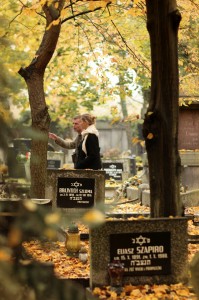
The New Jewish Cemetery in Wrocław is currently undergoing extensive renovation and is closed to tourists until further notice. For those visiting the graves of their loved ones, the cemetery is open on Wednesdays from 12:00 PM to 5:00 PM and Sundays from 9:00 AM to 1:00 PM.
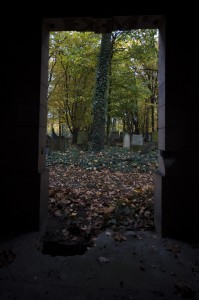
The unique photo gallery presented on this page aims to bring the beauty of the cemetery closer, as well as to compensate for the difficult access to this exceptional necropolis.
History of the cemetery
In the 1890s, the Jewish community in Wrocław began to realize that the cemetery on Ślężna Street would soon be full. The dynamic development of the city, especially the wealthy Krzyki district, made its potential expansion impossible, so a search began for a place to create a new cemetery. After a rather complicated procedure of buying the land – formally the city of Breslau – in June 1898 purchased the area around Gądowskie Field from Count Remus von Woyrsch from Pilczyce to create a municipal cemetery there, and hand over a part of the purchased land (for a fee) to the Jewish community for a new necropolis.
Problems
Before the city bought the plot, it proposed to the community that a road for hearses and pedestrians leading to the Christian cemetery should cross the cemetery. Of course, this idea was completely absurd and contrary to Jewish law. However, the influence of Jews in the City Council was strong enough to convince the councilors to abandon this idea.
As the community was preparing to close the transaction, further problems arose. First, the city wanted to reduce the sold plot by 10 meters from the street side (the exit route to Berlin), but there is a lack of documents that would sufficiently illuminate this matter, so historians assume that this obstacle was overcome without conflict.
The last obstacle was much more serious. The commander of Breslau, Major General von Witzendorff, opposed the establishment of the necropolis, arguing that the cemetery near the barracks number 10 used by the army would threaten the drinking water intakes located there. The protest of the district doctor only inflamed the conflict. An independent expert appointed to the case, as Leszek Ziątkowski notes in his book 'The History of Jews in Wrocław', after examining the area, ordered the drainage of the cemetery grounds, which was supposed to cut off competence disputes and silence any possible voices opposing its establishment. After all the battles fought, construction could begin.
Construction
The project was supervised by the well-known Jewish architect from Wrocław, Paul Ehrlich, who together with his brother was the creator of such important buildings as the Jewish Hospital on Wiśniowa Avenue (currently the Railway Hospital), the reconstruction of the interior of the White Stork Synagogue, or the Concert House in Wrocław (currently the concert hall of the Wrocław Philharmonic). Before starting work, the Wrocław architects carefully studied the plans of the latest Jewish cemeteries in Berlin and Hamburg, among others. In order for the huge investment to proceed smoothly, a special Cemetery Committee was established to control the construction and supervise the tenders. Among its representatives, one can mention many outstanding personalities later buried in the Old Jewish Cemetery on Ślężna Street, such as F. Pringsheim, E. Sachs, J. Schottlander, T. Oschinsky, H. Neustadt. It is also worth mentioning experts such as Heinrich Richter, the director of urban greenery, and Paul Ehrlich, the aforementioned architect.
As early as May 1900, a tender for drainage works was announced. After the initial acceptance of the concept proposed by Ehrlich, on July 4, 1900, he submitted the design of the chapel, the mortuary (pre-burial house), and the cemetery administration building. The work plan presented a month later by the architect assumed that the drainage works would be completed by the end of August 1900, and the paving and the first cemetery buildings would be finished by the spring of 1901.
As expected, construction was completed before 1902. The cost of the project was 444,948 marks, and preserved documents do not clearly state how such a huge investment was financed. As Leszek Ziątkowski argues – probably at the end of the 19th century, when the necessity of building a new cemetery was realized, money began to be collected in a special account – the so-called Friedhofsfonds. Collecting funds took quite a long time, because by the spring of 1899 there were already over 230,000 marks in the account.
The investment did not strain the community's budget, so considering these generally favorable financial conditions, both Paul Ehrlich and his assistant E. Lux received solid bonuses (the architect 3,000 marks, his assistant 300).
Opening
On February 14, 1902, the new cemetery was opened. As Ziątkowski reports: it was proposed to invite members of the community board and the assembly of representatives, both cult commissions, synagogal and poverty commissions, the board of the social welfare commission, the 'eighteen men', people involved in the construction of the cemetery, and prominent figures from the city. The culmination of the ceremony was to be the handing over of the keys to F. Pringsheim by the master builder P. Ehrlich.
The first funeral took place at the cemetery on March 12, 1902. Salomon Brann, a commissioner who died in the Jewish Hospital of the Frankel Foundation, was buried. The deceased was 63 years old and was the father of the well-known historian of Silesian Jews, M. Brann.
Press reports from the opening of the cemetery praised the investment: it was written that while maintaining the generally applicable rules of the art of establishing burial places, the new necropolis was maintained as a garden with grassy clearings, groups of trees, and places for monumental tombstones. The cemetery was built along an axis running from the main gate, marked by a grass-sown space. On the right side of the entrance was a two-story cemetery administration building, and on the left side, a chapel connected by a covered gallery with the pre-burial building (mortuary). The remains of these buildings can still be observed at the cemetery. The chapel was a central building with a dome covering a room that could accommodate up to 400 people. It was built in the Neo-Romanesque style from unplastered brick; inside it was decorated with paintings. Three entrances led to it, including one to the mortuary.
Immediately after opening the cemetery, efforts were made to improve its functioning by expanding the cemetery gardening, which was responsible for looking after the graves. The next element was the completion of works related to water management, primarily getting rid of excess water flowing from the drained area and regulating the sewage management from the buildings located at the cemetery. The last issue was to ensure access to drinking water for the residents serving the cemetery.
The expansion of the cemetery in the following years led to topographical changes: the extension of the necropolis to Pilczycka Street, then the construction of wall tombs, or the urn field created in the 1920s.
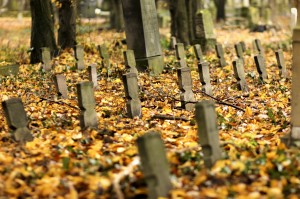
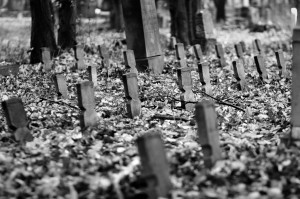
At the beginning of World War I, it was decided to create a section for Jewish soldiers who died on various fronts (its central part in the photo below).
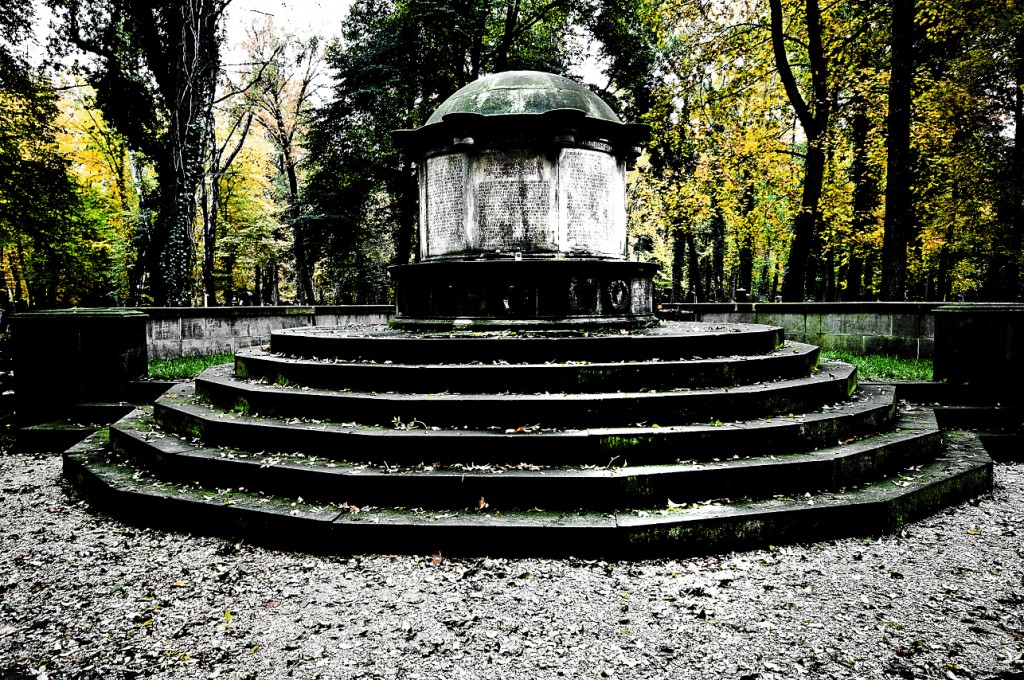
This is how the concept of the monument was described in the Jewish Gazette: together, just as the noble goal that united the fighters on the road to death was common, just as the suffering and danger that connected all professions and social classes were common, so together, without any differences, lie the buried fallen. The same modest stones, whose simple, curved outline clearly stands out from the green yew hedge, the impact of which will naturally grow over the years. The entire field of honor is surrounded by a ribbon of low fieldstone wall overgrown with rock plants; a wall that resonates with the war graves located in the open spaces of the battlefields and which creates that connection. All this should express the community of fates, and the low, grass-sown mounds of graves planted with ordinary, simple flowers should deepen this impression of community.
The great patriotism that shines through these words can be found in many places in the cemetery – above all in the beautiful inscriptions, which often speak of heroes fallen for the Reich. This patriotism is even more surprising as it does not end with the onset of the Nazi era – even in the 1940s one can find many inscriptions of those who gave their lives for Germany, although at the same time there was already a lot of tombstone information about those deported to the east, about those who died in ghettos and concentration camps. The cemetery on Lotnicza Street amazes with the directness of such textual tombstone forms.
The period of Nazi persecution
In 1943, after the deportation of Wrocław Jews – mainly to the ghetto in Czech Terezin (Theresienstadt) – there remained about 600-700 people of Jewish origin in Wrocław, who were either married to non-Jews or were defined by Nazi legislation as "Mischlinge" (mixed-race). In mid-June 1943, the NSDAP Gauleiter for Lower Silesia, Karl Hanke, decided to create a medical station for these people in the administration building at the cemetery on Lotnicza Street. In the 'jüdische Krankenstation' worked five doctors (including a surgeon, internist, pediatrician, general practitioner) and three nurses. By the end of 1944, the station had admitted several hundred patients, suffering mainly from senile, chronic diseases.
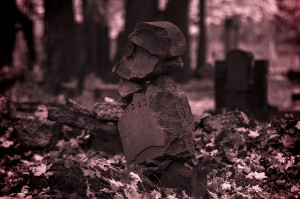
The patients of this facility were also Jewish prisoners of concentration camps from Wrocław and the surrounding areas. The medical station staff was obliged to bury the dead brought from the camps – mainly victims of starvation, diseases, and brutal treatment. Between May 20 and August 20, 1944, 16 men and women from Belgium, France, the Netherlands, and Poland who had been brought from labor camps, including those in Maślice and Sołtysowice, were buried at the necropolis. The place of their nameless burial is located near the grave of the Hadda family, at the eastern end of the East-West Axis.
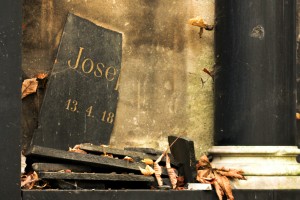
This is how Karla Wolff, a nurse working in the medical station at the cemetery, recalls these events: before that administration building at the cemetery in Kozanów, which was located far outside the city, we stood with a ladder wagon loaded with the miserable equipment that had been allocated to us; a few beds, tables, kitchen equipment, instruments, etc. [...] The long-abandoned administration building was cleaned up. The florist shop, where earlier, before going to the grave, one could buy flowers, was changed into an operating room. On the ground floor there were also two doctor's offices, an office, four rooms for the sick, and a kitchen. On the first floor there was a laboratory and an isolation ward.
They phoned from the camps in the morning that we should expect such and such a number of dead. We were also a cemetery and had to take care of the burial of those unfortunate Jews. They were not murdered, shot or gassed; they were 'only' starved to death or died of some disease, often they were also treated too brutally. We saw the marks.
The medical facility at the cemetery on Lotnicza Street operated until the end of 1944. Most likely, during the military operations, the cemetery buildings – the chapel and the cemetery administration building – were destroyed (although the chapel's roof was only partially destroyed, it was demolished only after the war).
In the final period just before the liberation, the army prepared a place for mass burials in the cemetery. This was agreed to by the financial authorities, who acted as the owner after the expropriation of this property.
In the post-war period, the Jewish cemetery had a lot of luck anyway – it was not razed to the ground, as was done with the adjacent cemeteries. It was used by the reviving community as early as 1945.
However, the new graves destroyed the earlier planning layout, as they were placed in the front part of the cemetery. Some of the new tombstones were made from fragments of dismantled old tombstones – the communist lack of materials left a significant mark on the cemetery. The tombstones that appeared after World War II very often – in addition to the deceased – also commemorated his/her family who died during the Holocaust.
The time of war and the years of communism severely devastated the cemetery. The reviving Jewish Community in the 1990s began a long and tedious process of renovating the cemetery, which continues to this day.
Source: Leszek Ziątkowski – The History of Jews in Wrocław