
History
As Leszek Ziątkowski argues in his book Dzieje Żydów we Wrocławiu (The History of Jews in Wrocław), there is something that distinguishes Wrocław from other European cities where Jewish settlement developed. Walking through Kraków or Berlin, we can learn from older residents where the synagogue, mikveh, hospital, or other institutions of Jewish communities used to be. In Wrocław, due to the post-war population exchange, cultural continuity was broken.
For several decades now, historians, residents, and tourists have been surprised that it was precisely the Jewish community in Breslau that played such a significant role in the history of the European diaspora. It was in Wrocław, alongside Berlin and Königsberg, that the foundations of the emancipation movement – the Haskalah – were formed. It was in Wrocław, amid disputes between religious factions (progressive and orthodox), that the foundations were laid for the currently most dynamic branch of Judaism: the Conservative movement.
Within the walls of the Theological Rabbinical Seminary on today's Włodkowica Street, in response to the emerging (also in Wrocław!) liberal movement, Zechariah Frankel derived what was later called Positive-Historical Judaism, from which Conservative Judaism (Masorti) was born. Thus, two of the largest contemporary branches of Judaism trace their origins very closely back to our city.
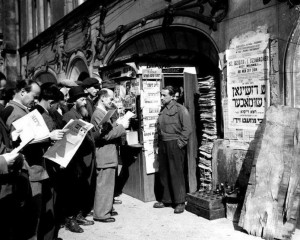
One of the most interesting Jewish communities in Europe ceased to exist during the Nazi era. It is enough to take a walk through the cemetery on Ślężna Street to see what exceptional people created it. On the other hand, few of us know that after World War II, Wrocław became the center of a new Jewish settlement in Poland. A community flourished here anew with Jewish newspapers, a theater, and schools. Once again, after 1968, the community ceased to exist.
The reviving contemporary community also aims to remember this extraordinary history. In the White Stork Synagogue, we can admire the exhibition "History Regained". We can boast that our knowledge is already very extensive and that the memory of Wrocław's Jews will no longer be forgotten. But perhaps it is worth looking at this history from its very beginning…
In the Middle Ages, Wrocław was one of the larger centers of Jewish population in Central Europe. A Jewish community certainly existed in the first half of the 12th century. Its founders may have been Jewish refugees from Prague mentioned by the Czech chronicler Cosmas.
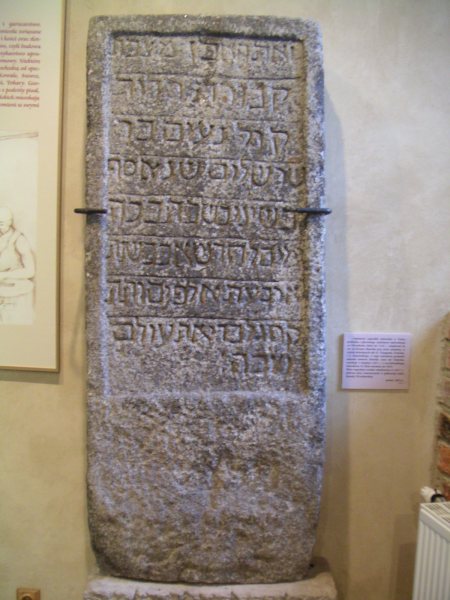
The oldest material evidence of the presence of Jews in Wrocław is the tombstone of cantor David, son of Sar Shalom, who died on August 4, 1203 – which proves that the cemetery was already active at the turn of the 12th and 13th centuries.
Initially, the legal status of Wrocław's Jews was very favorable – they remained under the special protection of the Duke. In 1267, the situation changed as a result of the decrees of the provincial synod of the Archbishopric of Gniezno in Wrocław. The existing freedoms of Jews were restricted, and special residential zones (ghettos) were designated. In each city, only one such place and only one place of religious assembly (synagogue) could exist.
In the years 1273–1290, the dukes issued numerous documents and privileges aimed at protecting the Jewish population. After 1273, such a document was issued by Duke Henry IV Probus. By virtue of this decree, Wrocław's Jews were guaranteed the safety of their persons and property, as well as the inviolability of their cemeteries. This privilege was later confirmed by Duke Henry V the Fat.
Jews engaged in trade, usury, and crafts. Among Jewish artisans, one could find butchers, bakers, and cooks. At the beginning of the 14th century, there were as many as 12 Jewish meat stalls in Wrocław.
In the 14th century, the situation of Jews significantly deteriorated. In 1349 and 1360, pogroms occurred, after which Jews were expelled from Wrocław. Before 1349, 70 Jewish families lived in the city; after the pogrom, only 5 or 6 remained. Soon, however, Jews resettled in the city again.
In 1453, the Franciscan friar and inquisitor John of Capistrano arrived in Wrocław. As a result of his sermons, in which he accused Jews of various forms of sacrilege (desecration of the host, kidnapping and killing of a Christian child), a trial took place, followed by the burning of 41 Jews in today's Solny Square.
The property of the remaining Jews was confiscated, and they were expelled; children under 7 were baptized and given to Christians. These events marked the end of the medieval Jewish community in Wrocław, sealed on January 30, 1455, by King Ladislaus the Posthumous's law banning Jews from permanent residence – ius Judaeos non tolerandis.
The medieval Jewish quarter encompassed today's streets: Uniwersytecka, św. Barbary, Nożownicza, Uniwersytecki Square, and the northern parts of Kuźnicza and Więzienna streets. Until the 19th century, street names testifying to their original character remained – Judengasse and Rabbinergässel (Jewish and Rabbinical alleys). Synagogues were also located within the quarter – despite the decrees of the 1267 synod, several operated in Wrocław.
Until the mid-17th century, there was no Jewish community in the city, but Jews appeared here during fairs, markets, and church holidays. The first Jew to settle in 1657, after more than 200 years of absence, was Zachariasz Lazarus from Náchod – a mint leaseholder. He founded the modern Jewish community, and the first synagogue was established in his home.
In the 17th century, Jews did not have their own cemetery – they buried their dead in Brzeg Dolny, Krotoszyn, and even in Biała, Leszno, and Głogów.
In 1722, 775 Jews lived in the city – they were mainly occupied with trade and crafts. However, in 1738, Emperor Charles VI ordered all "unprivileged Jews" to leave Wrocław.
The situation changed after Silesia came under Prussian rule. In 1744, King Frederick II issued an edict regulating the status of Jews; their number was limited, but it made it possible to establish a recognized community. The municipal ordinance of 1808 allowed Jews to acquire land and gave them the rights and duties of townspeople, and in 1812 the emancipation edict equalized the rights of the Jewish community with other Prussian citizens.
From the 18th century, Jews settled around the former Jewish Square (now Bohaterów Getta Square) and in the quarters enclosed by the streets: Krupnicza, św. Antoniego, Ruska, św. Mikołaja and the alleys along Kazimierz Wielki Street. In the territory of the Jewish quarter thus created, most of the institutions associated with the Jewish community were also located.
In 1744, Frederick II made four inns near Jewish Square available to Jewish merchants. By the end of the 17th century, seven synagogues operated in this area.
In the 1830s, a conflict broke out between conservatives and liberals over the appointment of the second rabbi, Abraham Geiger – a promoter of Reform Judaism. This led to a split in the 1840s and the creation of two cult commissions with two chief rabbis – orthodox and liberal. The first communal liberal rabbi was Abraham Geiger – an eminent Jewish theologian and advocate of Reform Judaism.
After Hitler came to power, the situation systematically deteriorated. In 1933, public rights of the Jewish population began to be restricted. In 1935, the Nuremberg Laws came into force, sanctioning legal inequality based on criteria of "blood and race". Steps were also taken to eliminate them from economic life through ministerial decrees, which were implemented by municipal authorities. As a result of antisemitic terror, some Jews emigrated from Germany.
The climax of antisemitic sentiment occurred during "Kristallnacht", which was particularly brutal in Wrocław. The New Synagogue was set on fire and blown up. The remaining synagogues were vandalized and their equipment partially burned, but the buildings survived. About 500 Jewish shops were destroyed, 10 Jewish inns and about 35 companies were ruined. 2,200 Wrocław Jews were sent to Buchenwald concentration camp.
From late 1941 to mid-1944, Lower Silesian Jews were deported in 11 transports to Kaunas, Izbica, Theresienstadt, Auschwitz, Sobibór, and Bełżec.
After 1945, a large group of Polish Jewish Holocaust survivors settled in Wrocław, which became a strong center of Jewish settlement. From the beginning, the city became a center of Jewish settlement. Pioneers of the Jewish community in Wrocław and Lower Silesia were former prisoners of the Gross-Rosen camp and its numerous sub-camps. From September 1945, Jewish emigrants from areas occupied by the Soviet Union arrived in Wrocław. By the end of 1946, the number of Jews in the city was approximately 15,000.
In May 1945, the Jewish Religious Congregation began its activities, operating the White Stork Synagogue and three houses of prayer. Wrocław became the seat of the Provincial Jewish Committee. Numerous Jewish organizations, schools, and social facilities began to be created in the city.
After March 1968, Jewish life in Wrocław virtually ground to a halt, although the TSKŻ (Social and Cultural Association of Jews in Poland) and the congregation of the Mosaic faith continued to operate.
The revival occurred after 1989. Scientific conferences, exhibitions, and cultural events began to be organized. Research into fascism and the Holocaust in Silesia, as well as the history of Lower Silesian Jews after World War II, was further developed. In 1993, the Center for the Study of the Culture and Languages of Polish Jews was established at the University of Wrocław, transformed in 2003 into the Studies on Jewish Culture and Languages.
Until 2006, an independent Jewish Religious Community functioned in Wrocław, subsequently incorporated into the Union of Jewish Religious Communities in Poland and transformed into the ZGWŻ Branch in Wrocław. The TSKŻ continues to operate in the city, as well as several organizations dealing with Jewish culture and education – including the Bente Kahan Foundation and the GESHER Jewish Culture and Education Foundation.
Portions of the text come from the website: http://www.sztetl.org.pl/pl/article/wroclaw/5,historia/